
Fertility Medications: what are they?
Fertility treatment comes with a lot of medications, and the pharmacy delivery alone can feel overwhelming. The good news is that each one has a specific job, and they're used in a predictable order.
Here's what she may be taking, stage by stage:
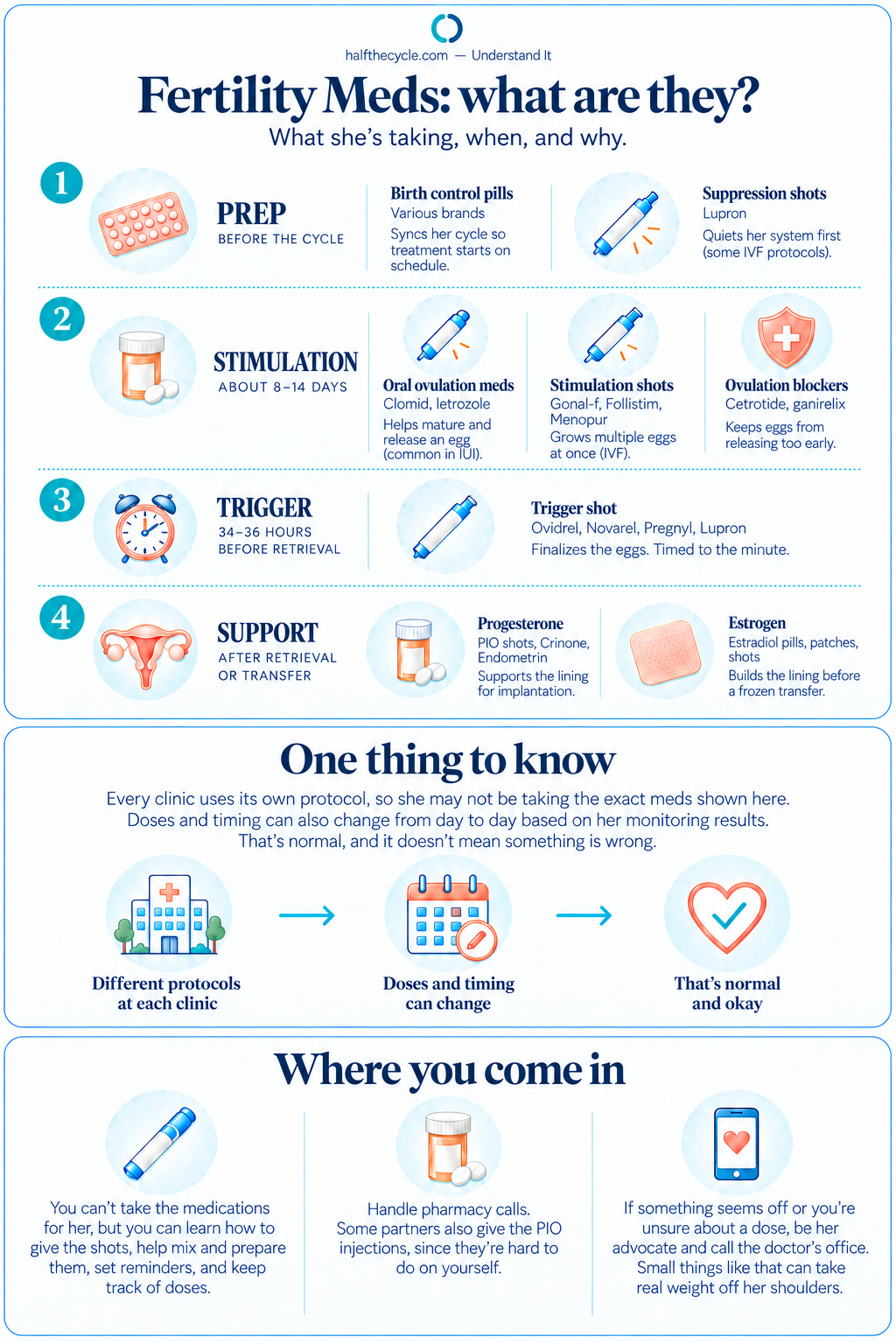
Stage 1: Prep
Birth Control Pills
It sounds backwards, but many clinics start an IVF cycle with a few weeks of birth control. It helps quiet her system and sync her cycle so treatment can start on schedule.Suppression Shots
Some IVF protocols use a medication like Lupron before stimulation begins. It temporarily turns down her body's natural hormone signals so the clinic has more control over the cycle.
Stage 2: Stimulation
Oral Ovulation Meds
Pills like Clomid or letrozole are common in IUI cycles. They encourage her ovaries to mature and release an egg, and are usually taken for about five days early in her cycle. Side effects can include hot flashes, headaches, and mood swings.Stimulation Shots
In IVF, injectable medications like Gonal-f, Follistim, or Menopur help multiple eggs grow at once. They're usually given under the skin every evening for about 8–14 days. As her ovaries grow, she may feel bloated, tender, and tired.Ovulation Blockers
Partway through stimulation, medications like Cetrotide or ganirelix are added to keep her body from releasing the eggs too early. This often means two or three shots a night, and injection sites may sting or bruise.
Stage 3: Trigger
Trigger Shot
When the follicles are ready, she'll take a precisely timed trigger shot, such as Ovidrel, Novarel, Pregnyl, or Lupron. It helps the eggs complete their final maturation. Timing matters here. Egg retrieval or IUI is scheduled around it, typically about 34–36 hours later.
Stage 4: Support
Progesterone
After retrieval, IUI, or during a frozen transfer cycle, progesterone helps prepare and support the uterine lining for implantation. It may be given as progesterone in oil (PIO) injections into the muscle or as vaginal inserts like Crinone or Endometrin. If she becomes pregnant, she may continue it for several more weeks.Estrogen
Estrogen helps build up the uterine lining, especially before a frozen embryo transfer. It can come as pills, patches, or injections, and the dose may be adjusted after lining checks.