
IVF: step-by-step
IVF (in vitro fertilization) is the most involved fertility treatment — but breaking it into steps makes it much less overwhelming.
Here's what actually happens step-by-step:
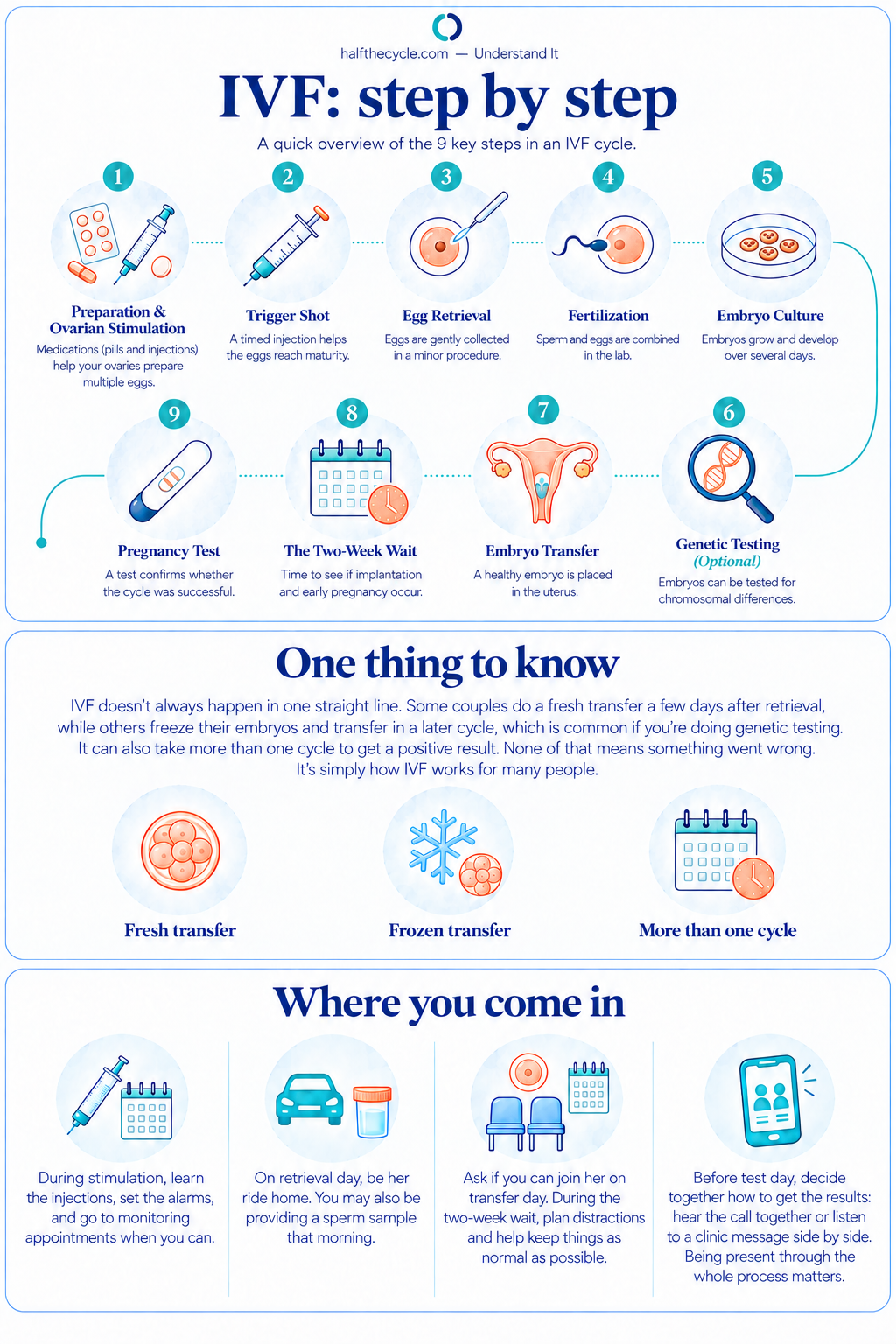
Ovarian Stimulation (Days 1–10ish)
Your partner takes daily hormone injections to encourage her ovaries to produce multiple eggs instead of the usual one. This phase involves frequent monitoring — bloodwork and ultrasounds every few days to track follicle growth.Trigger Shot
Once the eggs are mature, a "trigger shot" is timed precisely to ripen them for retrieval — usually given 36 hours before the procedure.Egg Retrieval
A minor surgical procedure (done under sedation) where a doctor retrieves the eggs directly from the ovaries using a thin needle. Takes about 20–30 minutes; recovery is same-day.Fertilization
In the lab, retrieved eggs are combined with sperm (either mixed together or injected directly, called ICSI) to create embryos.Embryo Culture
Fertilized eggs are monitored in the lab for 3–6 days as they develop into embryos. Not all will make it — this is a normal (if hard) part of the process.Genetic Testing (See our PGT Testing blog)
Some patients choose to test embryos for chromosomal abnormalities (PGT-A) before transfer.Embryo Transfer
A healthy embryo is placed into the uterus using a thin catheter — no sedation needed, quick and often described as similar to a pap smear.The Two-Week Wait
The hardest part for many couples: waiting roughly 10–14 days to test for pregnancy.Pregnancy Test
A blood test (beta hCG) confirms whether the transfer was successful.