
Listening: when she needs to vent, not a solution
She comes home from an appointment upset, or she's been reading forums at midnight, and she starts talking. Your instinct kicks in: find the problem, offer a fix. "Why don't you call the nurse?" "Maybe we should switch clinics." And somehow the conversation gets worse. Most of what's hard about fertility treatment can't be fixed by either of you. When she talks about it, she's usually looking for company in it.
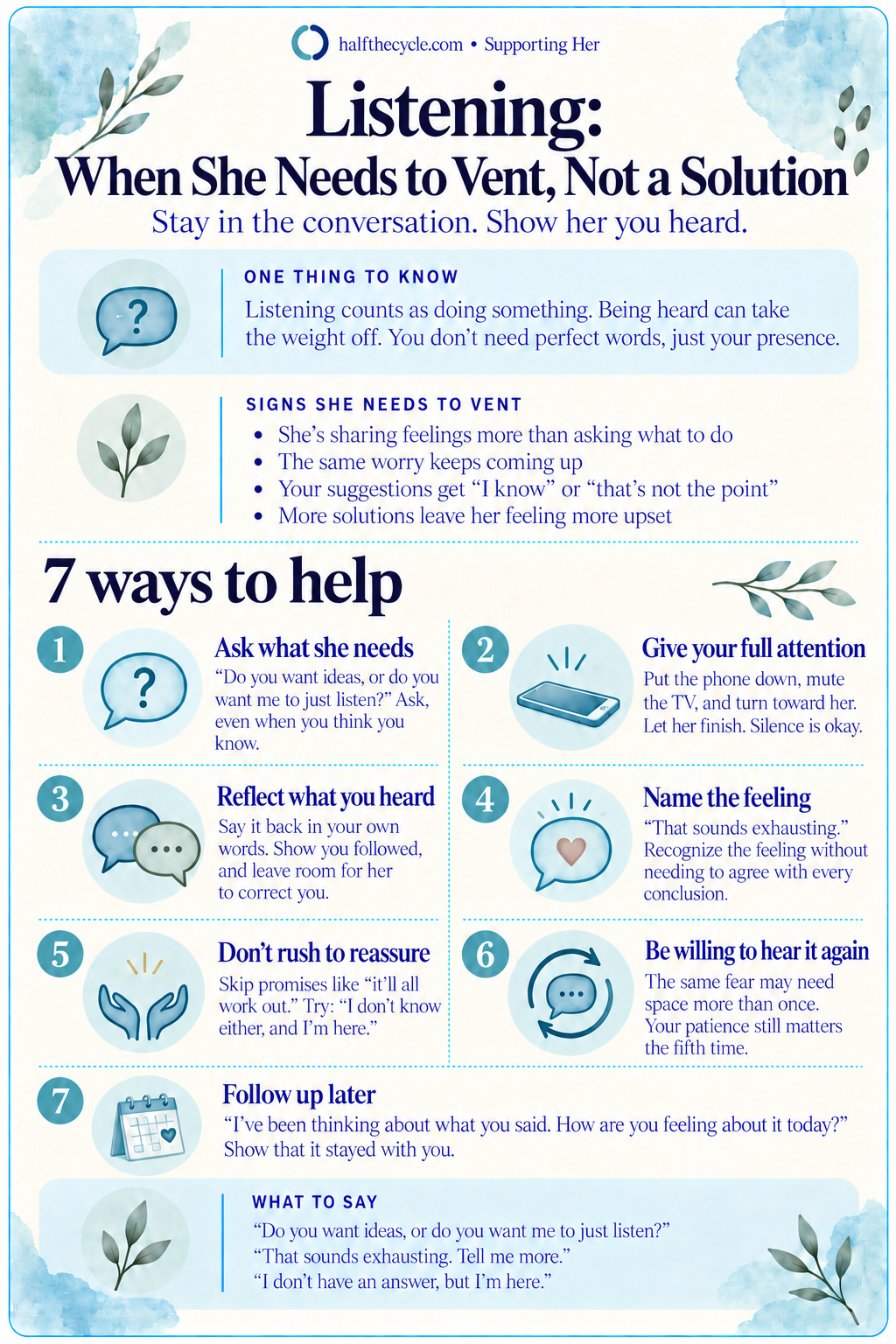
One thing to know: Listening counts as doing something. It can feel passive, but being heard is often what takes the weight off. You don't need the perfect words. You need to stay in the conversation.
Signs she needs to vent
She's describing how something felt more than asking what to do
She's brought up the same worry before
She starts with "I just can't believe" or "I'm so tired of"
Your suggestions get "I know" or "that's not the point"
She gets more upset the more solutions you offer
What helps
1. Ask which one she needs
"Do you want ideas, or do you want me to just listen?" takes the guessing out of it. Ask it often. She'll appreciate the question even on the days she isn't sure of the answer.
2. Give her your full attention
Put the phone down, mute the TV, and turn toward her. Let her finish without jumping in, even to agree. A few seconds of silence is fine.
3. Say back what you heard
Put it in your own words: "So the nurse rushed you, and you left with more questions than you came in with." It shows you followed, and it gives her the chance to correct you.
4. Name the feeling
"That sounds exhausting." "No wonder you're angry." You don't have to agree with every conclusion she reaches to recognize how she feels.
5. Don't rush to reassure
"It'll all work out" is a promise you can't keep, and she knows it. Try "I hope so too" or "I don't know either, and I'm here."
6. Be willing to hear it again
She may need to go over the same fear many times. Repeating it is how people work through things that have no answer. Your patience the fifth time matters as much as the first.
7. Follow up later
The next day, come back to it: "I've been thinking about what you said about the nurse. How are you feeling about it today?" It tells her the conversation stayed with you.
What to say
"Do you want ideas, or do you want me to just listen?"
"That sounds exhausting. Tell me more."
"I don't have an answer, but I'm here."
The bottom line
You don't have to solve what she's feeling. Stay in the conversation, show her you heard it, and come back to it later. Most days, that's the help she was asking for.