
Semen Analysis: what to expect
When fertility testing starts, most of the attention goes to her: bloodwork, ultrasounds, and more appointments. But one of the first and most important tests is his. A semen analysis looks at the health of sperm, and it's often the partner's first real step into the process.
It's simple, quick, and completely routine for the clinic. It can still feel awkward or stressful, and that's normal. This guide walks through what happens, how to prepare, and what the results mean.
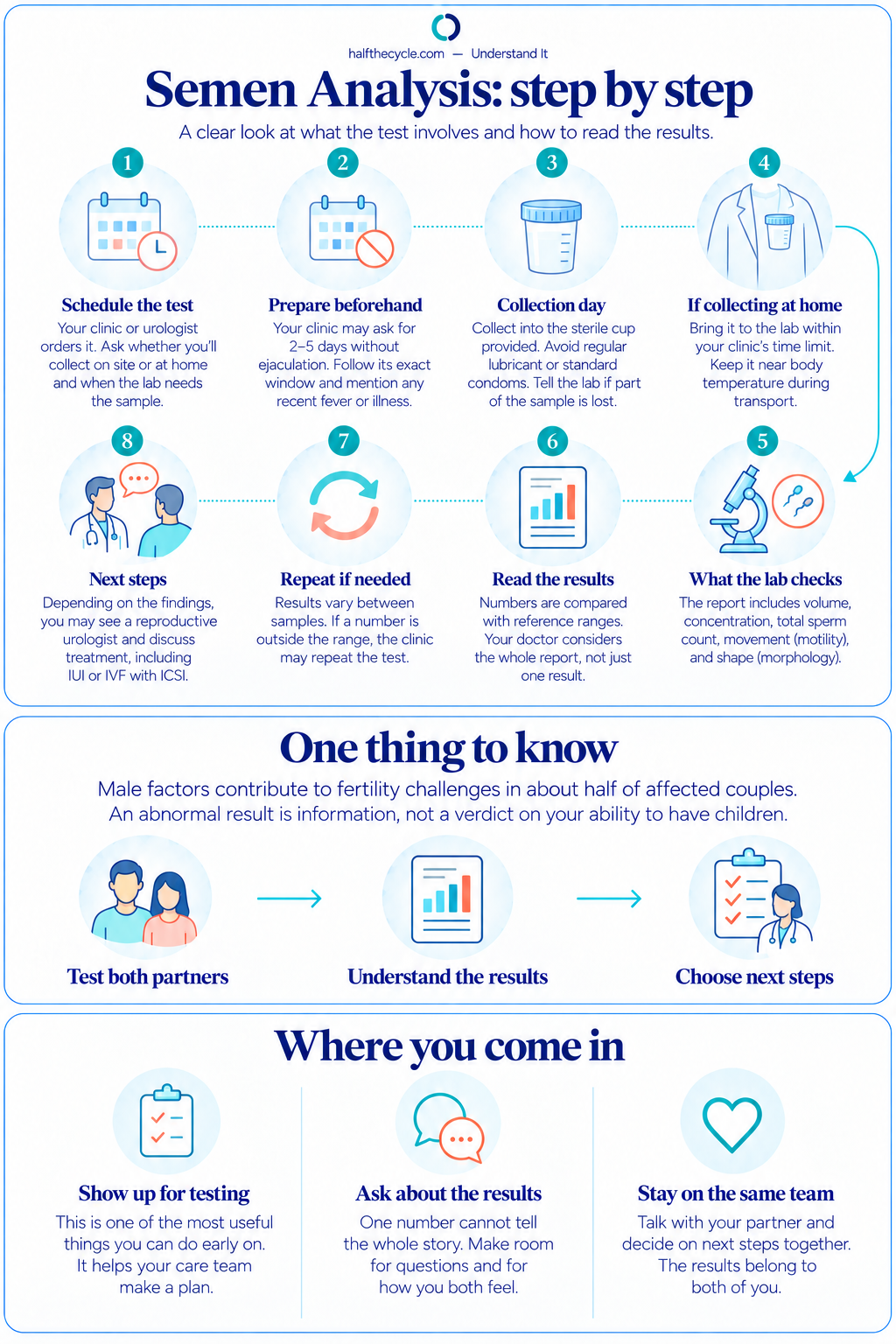
Scheduling the test
Your clinic or a urologist will order the analysis. Some clinics have a private collection room on site, and others allow collection at home if you can get the sample to the lab quickly. Ask which option you have.Preparing beforehand
Most clinics ask you to avoid ejaculation for about 2–5 days before the test. Too short a break can lower the count, and too long can affect sperm movement. Follow your clinic's exact window.Things that can affect results
Sperm take about 2–3 months to develop, so what you do now shows up in future samples. Heat from hot tubs, saunas, and laptops on your lap can affect results, as can heavy drinking, smoking, vaping, and cannabis. A recent illness with a fever can also temporarily lower your numbers, so tell the clinic if you've been sick in the past few months.Collection day
The sample is collected by masturbation into a sterile cup the clinic gives you. Don't use regular lubricant, saliva, or a standard condom, since these can harm sperm. If you need lubricant, ask the clinic for a sperm-safe option. Try to collect the entire sample, because the first part usually contains the most sperm. If any is lost, just tell the lab. It happens.If you collect at home
Get the sample to the lab within the time your clinic gives you, usually within about an hour. Keep it close to body temperature, such as in an inside jacket pocket, not in the car's cup holder on a hot or cold day.What the lab measures
The lab checks several things:
Volume: how much semen there is.
Concentration: how many sperm per milliliter.
Total count: the total number of sperm in the sample.
Motility: how many sperm are moving, and how many are moving forward well.
Morphology: how many sperm have a typical shape.Understanding the results
Results usually come back within a few days. Your report will compare your numbers to reference ranges. For context, the World Health Organization's lower limits are about 16 million sperm per milliliter, 42% total motility, and 4% normal shape.
That last number surprises a lot of men. It's normal for most sperm to be irregularly shaped. A morphology of 4% is considered within the normal range.
A single number outside the range doesn't tell the whole story. Your doctor looks at all the results together.What happens next
Sperm counts naturally vary from sample to sample, so if something looks off, the clinic will often repeat the test in a few weeks. If results are still abnormal, you may be referred to a urologist or reproductive urologist. Depending on the findings, treatment options range from lifestyle changes and medication to IUI or IVF with ICSI, where a single sperm is injected directly into an egg. Many male factor challenges are very treatable.