
2-Week Wait: what to expect
The transfer is done, and now comes the part nobody can speed up. The two-week wait (often shortened to "TWW" in fertility communities) is the stretch between embryo transfer and the pregnancy blood test. There are no appointments and very few updates, just waiting. For many couples, it's the most emotionally intense part of the whole cycle.
This guide covers what's happening in her body, what symptoms do and don't mean, and what the blood test results actually tell you.
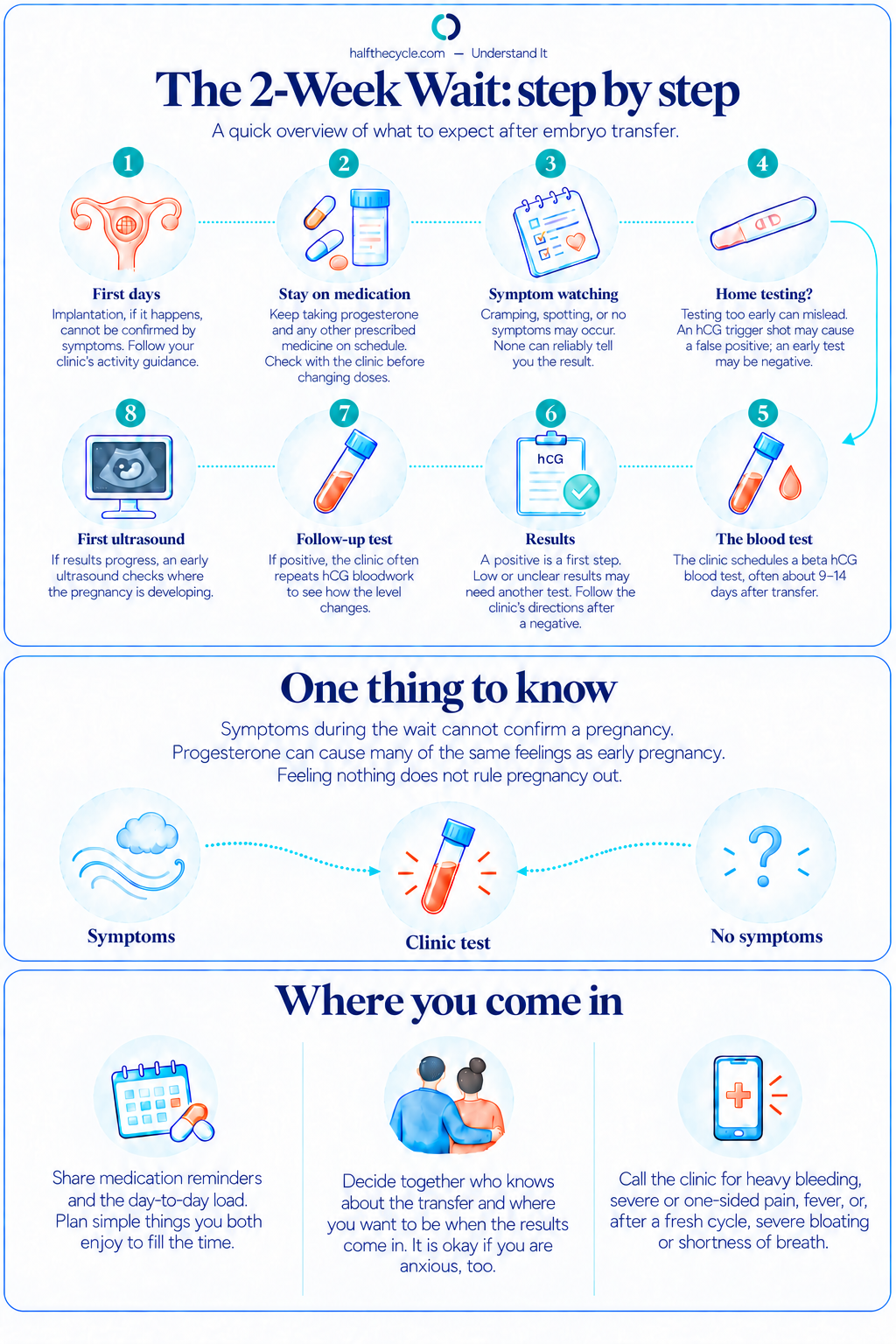
Days 1–5: Implantation window
If the embryo implants, it usually happens within the first several days after transfer. It's invisible and silent, and there's nothing she can do to help or hurt it by moving, laughing, or going about a normal day. Clinics vary on activity guidance, so follow yours.Staying on medication
Progesterone (and sometimes estrogen) continues throughout the wait. It supports the uterine lining so a pregnancy can hold. Missing doses matters, so set phone alarms for both of you. Partner tip: If you're giving progesterone shots, alternate sides and warm the area first. Many couples find a heating pad afterward helps with soreness.Days 6–10: The symptom-watching phase
This is when the mental checking gets loud. Light cramping or spotting can happen whether or not she's pregnant. Try to agree together not to treat every twinge as a clue.To test at home or not
Many clinics advise against home pregnancy tests during the wait. If a trigger shot containing hCG was used, it can linger and cause a false positive. Testing too early can also give a false negative. Decide as a couple before the wait starts whether you'll test at home, so it's not a tense conversation in the moment.5. The blood test (beta hCG)
Around 9–14 days after transfer, she'll get a blood draw to measure hCG, the hormone produced once an embryo implants. It's far more accurate than a home test because it gives an exact number instead of a yes or no. Some clinics also check progesterone at the same time to see if her dose needs adjusting.Understanding the results
Negative: hCG is below the clinic's cutoff, usually under 5 mIU/mL. The embryo didn't implant. Don't stop medication until the clinic tells you to. A period usually follows within days of stopping progesterone.
Positive: hCG is above the cutoff. This is a real, meaningful result, but it's the first step, not the final answer.
Low positive: hCG is detected but at a lower level than expected. It can go either way, which is why the next test matters.
There's no single "right" number. Healthy early pregnancies can start with a wide range of hCG levels. What doctors care about most is the trend.The follow-up blood draw
A positive result is usually followed by one or two more blood tests, spaced about 48 hours apart. In a healthy early pregnancy, hCG typically rises significantly, often roughly doubling every 48–72 hours. Levels that rise slowly, plateau, or drop can signal a problem. One possibility is a chemical pregnancy, an early loss that happens after implantation but before anything is visible on ultrasound. Your clinic will explain what your specific numbers mean.The first ultrasound
If the numbers rise well, the clinic will schedule an early ultrasound, usually a few weeks later, to confirm the pregnancy is in the uterus and look for a heartbeat. This is often the moment it starts to feel real.