Fertility Terms: what does it mean?
Fertility treatment comes with its own language, and a lot of it may be new at first. From follicle counts and betas to blastocysts and PGT, there are plenty of terms that become part of the conversation along the way.
Here, we break down the ones you’re likely to come across, in plain language, so you can better understand what’s happening and what it means for your journey.
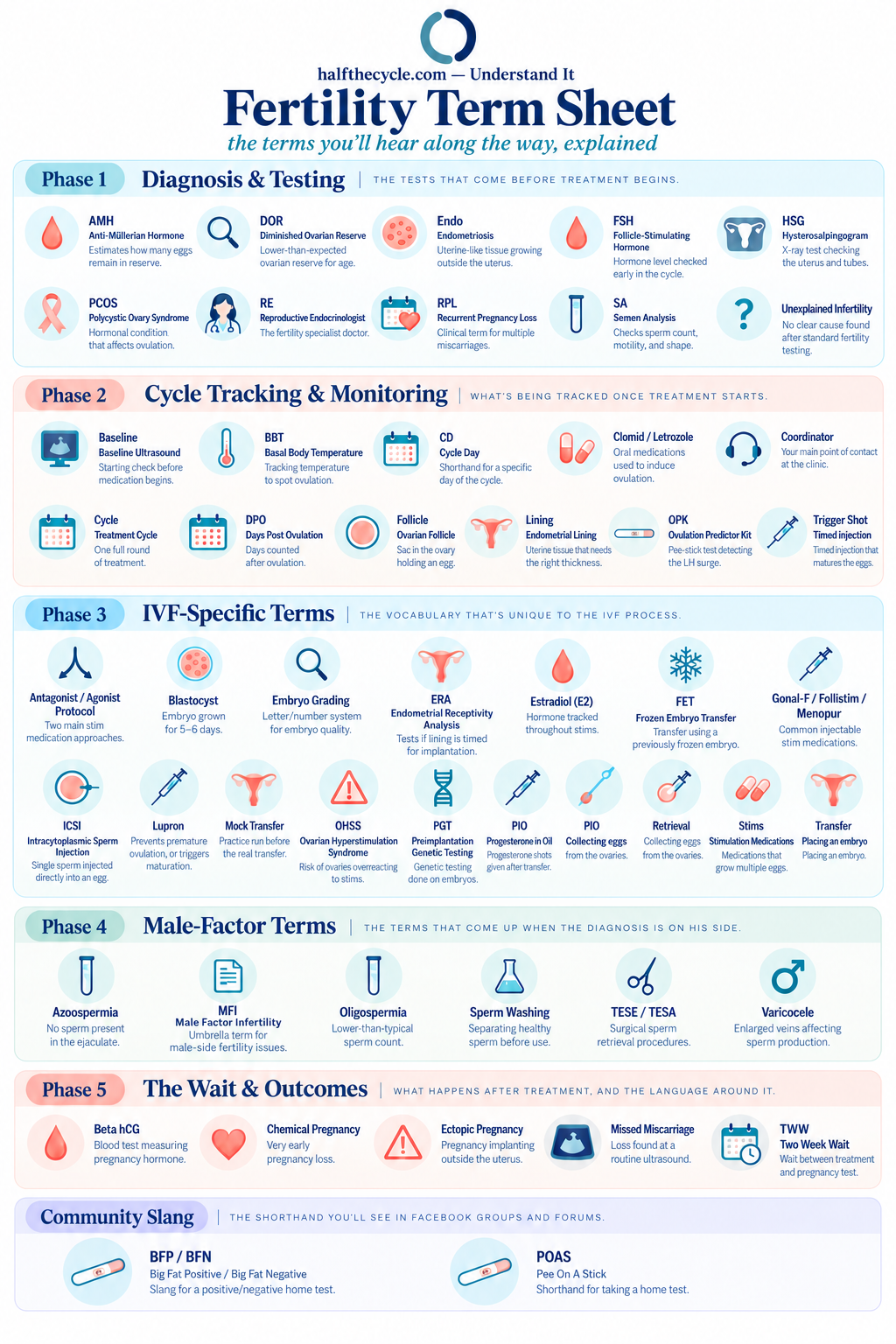
Phase 1: Diagnosis & Testing
AMH — Anti-Müllerian Hormone A blood test that estimates how many eggs are left in the ovarian reserve.
DOR — Diminished Ovarian Reserve Lower-than-typical egg quantity for a given age.
Endo — Endometriosis Tissue similar to the uterine lining growing outside the uterus, a common cause of infertility.
FSH — Follicle-Stimulating Hormone A hormone level checked early in the cycle; higher levels can signal lower ovarian reserve.
HSG — Hysterosalpingogram An X-ray test that checks if the fallopian tubes are open and the uterus is shaped normally.
PCOS — Polycystic Ovary Syndrome A hormonal condition that affects ovulation; one of the most common fertility diagnoses.
RE — Reproductive Endocrinologist The fertility specialist doctor, distinct from a regular OB-GYN.
RPL — Recurrent Pregnancy Loss The clinical term for multiple miscarriages, sometimes triggering additional testing.
SA — Semen Analysis The basic male-fertility test, checking sperm count, motility, and morphology.
Unexplained Infertility When all standard tests come back normal, but pregnancy still isn't happening.
Phase 2: Cycle Tracking & Monitoring
Baseline The ultrasound and bloodwork done at the start of a cycle to confirm everything is "quiet" before starting medication.
BBT — Basal Body Temperature Tracking temperature to spot ovulation patterns, more common in natural/unmedicated cycles.
CD — Cycle Day Shorthand used constantly on calendars and portals — "CD3" means day 3 of the period.
Clomid / Letrozole Oral medications used to induce ovulation, commonly used in IUI cycles.
Coordinator (Nurse Coordinator) The clinic staff member who manages scheduling, medication instructions, and day-to-day questions.
Cycle Shorthand for one full round of treatment.
DPO — Days Past Ovulation Common in forums — "8dpo" means 8 days after ovulation.
Follicle A fluid-filled sac in the ovary that holds an egg; tracked on ultrasound throughout the cycle.
Lining (Endometrial Lining) The tissue inside the uterus, which needs a certain thickness for an embryo to implant.
OPK — Ovulation Predictor Kit A pee-stick test that detects the LH surge before ovulation.
Trigger Shot An injection that tells the ovaries to finish maturing eggs on a precise, timed schedule.
Phase 3: IVF-Specific Terms
Antagonist / Agonist Protocol The two main medication approaches to stims; the clinic chooses based on individual response and history.
Blastocyst ("Blast") An embryo that has developed for about 5-6 days and reached a more advanced stage.
Embryo Grading The letter/number system labs use to describe embryo quality (e.g., "a 4AA blastocyst").
ERA — Endometrial Receptivity Analysis A test checking whether the uterine lining is timed correctly for implantation, often used after unexplained failed transfers.
Estradiol (E2) A hormone level tracked via bloodwork throughout stims, alongside follicle count, to monitor egg development.
FET — Frozen Embryo Transfer A transfer using a previously frozen embryo, done in its own separate cycle.
Gonal-F / Follistim / Menopur Common injectable stimulation medications used to help the ovaries produce multiple eggs.
ICSI — Intracytoplasmic Sperm Injection A single sperm is injected directly into an egg, often used for male-factor infertility.
Lupron A medication used to prevent premature ovulation during stims, or in some protocols to trigger final egg maturation.
Mock Transfer A practice run of the transfer procedure, done before the real one, to map the path to the uterus.
OHSS — Ovarian Hyperstimulation Syndrome A risk of stimulation medications where the ovaries overreact; clinics monitor closely to avoid it.
PGT — Preimplantation Genetic Testing Genetic testing done on embryos before transfer, to check for chromosomal issues or a known inherited condition.
PIO — Progesterone in Oil Intramuscular progesterone shots common after transfer, often given by the partner.
Retrieval — Egg Retrieval A minor procedure, done under sedation, that collects eggs from the ovaries.
Stims — Stimulation Medications Injectable hormones that encourage the ovaries to produce multiple eggs in a single cycle.
Transfer — Embryo Transfer Placing an embryo into the uterus, either "fresh" or frozen.
Phase 4: Male-Factor Specific
Azoospermia No sperm present in the ejaculate.
MFI — Male Factor Infertility The umbrella term for fertility issues originating on the male side; often how partners first hear their situation described.
Oligospermia A lower-than-typical sperm count.
Sperm Washing A lab process that separates healthy, motile sperm from semen before IUI or IVF use.
TESE / TESA — Testicular Sperm Extraction / Aspiration Surgical procedures to retrieve sperm directly when none is present in ejaculate.
Varicocele Enlarged veins in the scrotum that can affect sperm production; a common, treatable cause of male-factor infertility.
Phase 5: The Wait & Outcomes
Beta — Beta hCG The blood test that measures pregnancy hormone levels; a rising number over 48 hours is an early good sign.
Chemical Pregnancy A very early pregnancy loss, happening right around the time of the first positive test.
Ectopic Pregnancy When a pregnancy implants outside the uterus; a distinct risk from chemical pregnancy that requires prompt medical attention.
Missed Miscarriage When a pregnancy has stopped developing but the body hasn't yet recognized or passed the loss, often discovered at a routine ultrasound.
TWW — Two-Week Wait The stretch between insemination or transfer and the pregnancy test.
Community Slang
BFP / BFN — Big Fat Positive / Big Fat Negative Slang for a positive or negative home pregnancy test.
POAS — Pee On A Stick Shorthand for taking a home pregnancy test.