Egg Retrieval: step-by-step
Egg retrieval sounds like a big procedure, but the actual retrieval is usually one of the shortest parts of the IVF process. Most of the work happens in the days leading up to it.
Here’s what to expect, step by step:
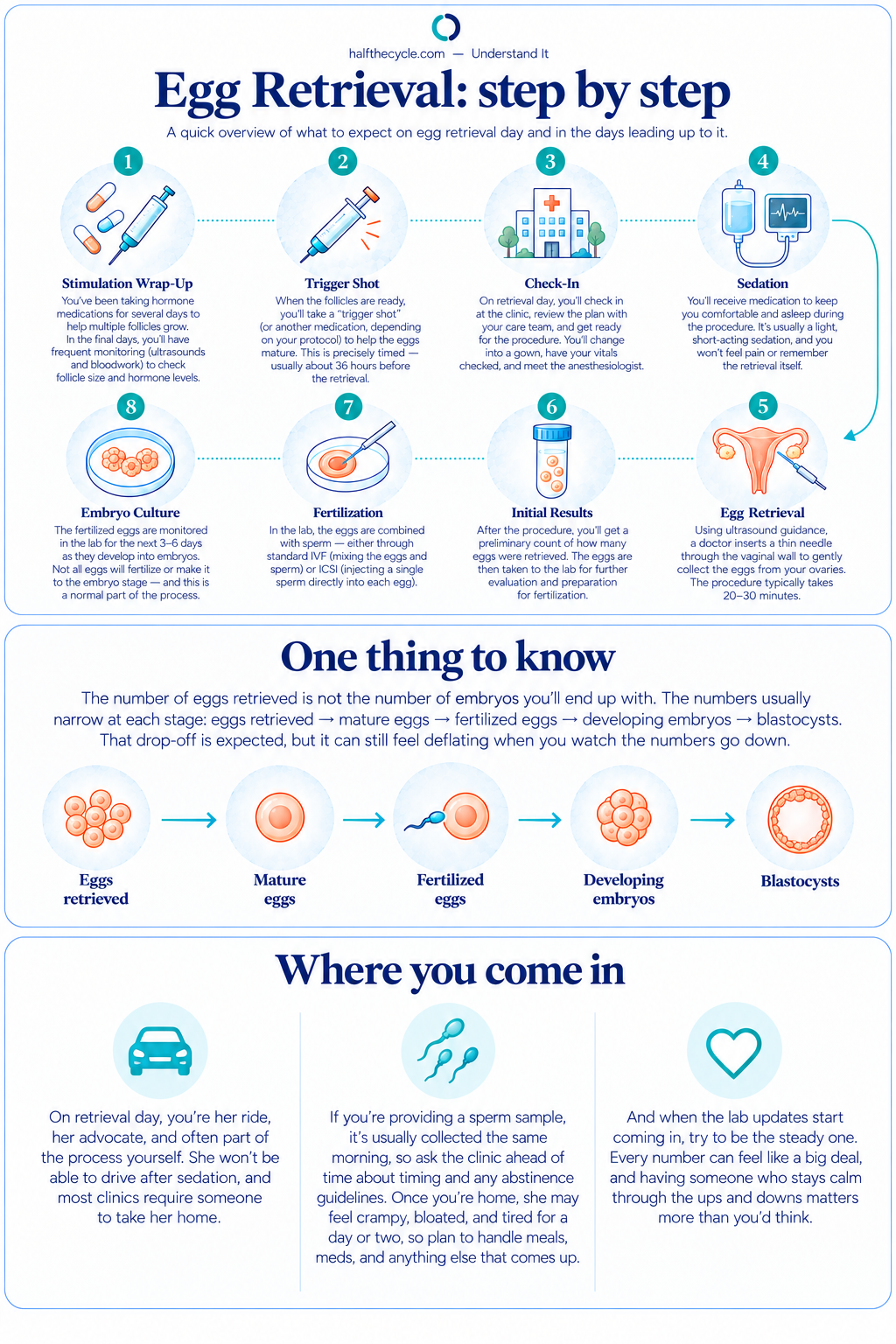
Stimulation Wrap-Up
Your partner has been taking hormone injections for several days to help multiple follicles grow. As retrieval gets closer, the clinic uses ultrasounds and bloodwork to monitor follicle size and hormone levels and decide when the eggs are ready.Trigger Shot
When the follicles are ready, she’ll take a precisely timed “trigger shot” to help the eggs complete their final maturation. Timing matters here. Retrieval is typically scheduled about 36 hours later, before ovulation occurs.Check-In
On retrieval day, you’ll arrive at the clinic, review the plan with the care team, and get ready for the procedure. She’ll typically change into a gown, have her vital signs checked, and meet with the anesthesia team. An IV may be placed depending on the clinic and type of sedation being used.Sedation
Medication is given to keep her comfortable during the procedure. The type of anesthesia varies by clinic, but many use short-acting IV sedation so she is asleep or deeply relaxed and doesn’t feel the retrieval.Egg Retrieval
Using ultrasound guidance, the doctor passes a thin needle through the vaginal wall and into the ovarian follicles to collect the fluid containing the eggs. The procedure itself usually takes about 20–30 minutes.Initial Egg Count
The collected fluid goes immediately to the lab, where an embryologist identifies the eggs. You’ll usually get an initial number of eggs retrieved that day. Important: this is only the first number. Not every retrieved egg will necessarily be mature or able to fertilize.Fertilization
Mature eggs are combined with sperm using conventional IVF or ICSI, where a single sperm is injected directly into an egg. The next day, the lab can usually tell you how many eggs successfully fertilized.Embryo Culture
Fertilized eggs are monitored over the next several days as they develop. Some will continue growing and some won’t. That drop-off is a normal part of IVF, even though watching the numbers change can be tough.