
Feeling Helpless: when you can’t fix it
When something goes wrong, most of us want to do something about it. Find the problem, make a plan, fix it. Fertility treatment takes that option away. You can't make the medications work faster, you can't make the embryos grow, and you can't make the phone call come back with good news. For a lot of partners, that feeling of helplessness is one of the hardest parts of the whole experience, and one of the least talked about.
One thing to know: Feeling helpless doesn't mean you're failing her. It usually means you care deeply about something that's out of your control. That's not a weakness. It's the reality of fertility treatment.
What it can look like
Helplessness doesn't always feel like helplessness. It can show up as:
Restlessness, or trying to research and plan everything
Frustration or irritability over small things
Pulling back or going quiet, because you don't know what to say
Feeling like a bystander in your own family's story
Guilt that she's carrying the physical side while you "just watch"
If any of these sound familiar, you're not alone. They're some of the most common things partners describe.
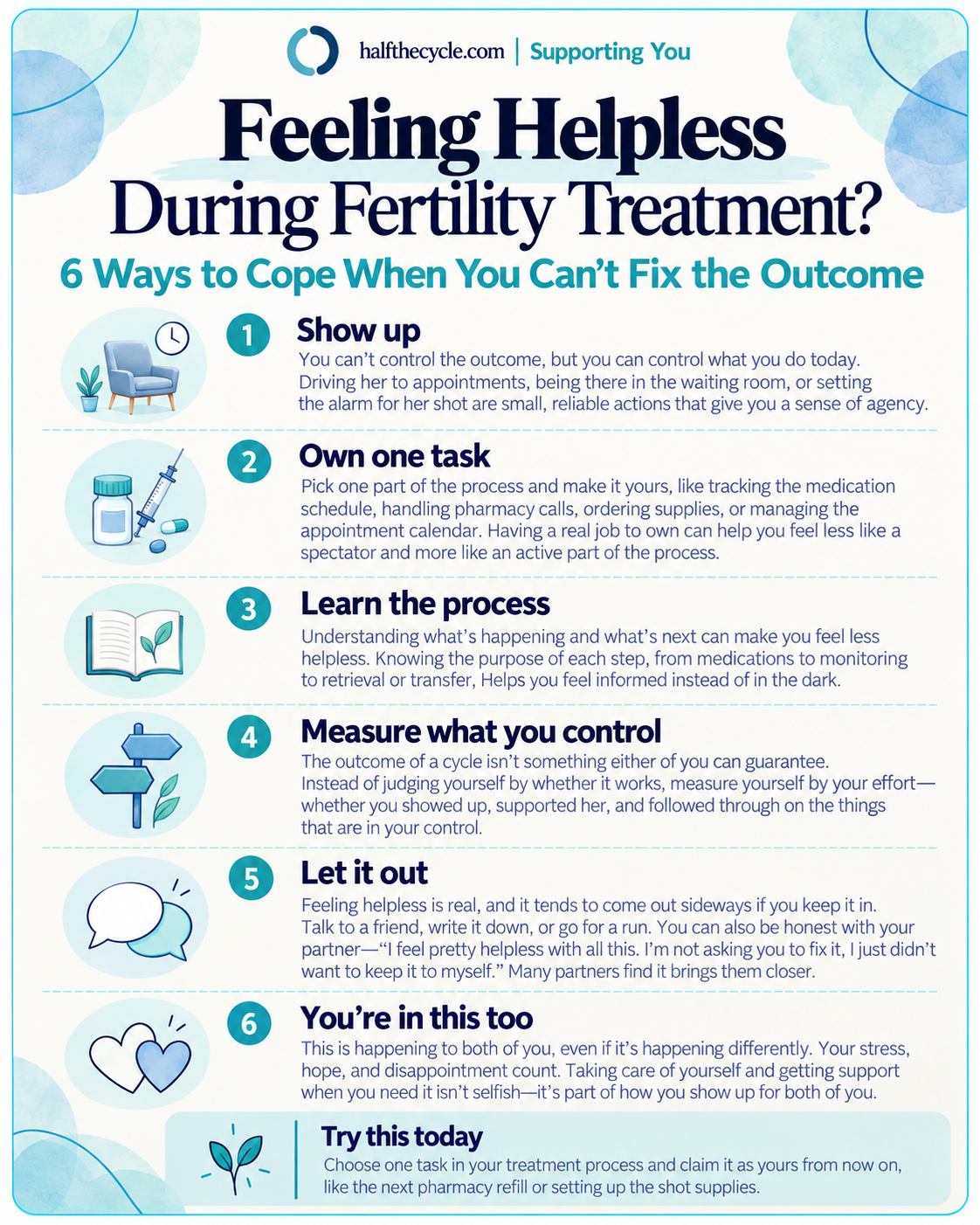
What helps
1. Shift from fixing to being there
She usually isn't looking for a solution. She's looking for someone beside her. Sitting with her after a hard appointment, holding her hand during an injection, or simply saying "This is really hard, and I'm here" often matters more than anything you could fix.
2. Take ownership of what you can control
There's a lot you can't change, but plenty you can carry. Track medication times, set reminders, handle pharmacy calls, manage the calendar, deal with insurance, or take over dinner on injection nights. Taking real work off her plate is one of the most meaningful ways to help, and it gives your energy somewhere to go.
3. Ask instead of guessing
"What would help most today?" is one of the most useful questions you can ask. Some days she'll want to talk, some days she'll want distraction, and some days she'll want space. Asking takes the pressure off both of you.
4. Learn the process
Understanding what's happening at each stage can make you feel less like you're on the sidelines. It also helps you ask better questions at appointments and know what's coming next. Our Understand It guides are a good place to start.
5. Let yourself feel it, too
You don't have to be the steady one every moment. It's okay to be scared, frustrated, or sad. Holding everything in tends to come out in other ways, so find somewhere to put it: a friend, a journal, a workout, or a counselor.
6. Talk to her about it
You don't need to hide that you feel helpless. Telling her "I wish I could do more" can bring you closer, as long as it's shared rather than handed to her to fix.
7. Know when to reach out for support
If the helplessness starts to feel heavy, if you're losing sleep, pulling away from people, or feeling hopeless, it's worth talking to a counselor, ideally one who understands fertility treatment. Getting support for yourself is part of supporting her.
The bottom line
You can't fix this. But you're not powerless, either. Showing up, carrying the load where you can, and staying connected to her and to yourself are some of the most important things anyone can do in this process.