
Disagreeing: when you want different next steps
Fertility treatment is full of big decisions, and you won't always agree on them. One of you may be ready to try again right away while the other needs a break. You may see the financial limit differently, or feel differently about donor options, how many embryos to transfer, or when it's time to stop. Disagreeing doesn't mean something is wrong with your relationship. It means you're both invested in an outcome that matters deeply, and you're each bringing your own fears, hopes, and limits to the table.
One thing to know: Most disagreements during treatment aren't really about the decision itself. They're about what's underneath it: fear of losing hope, worry about money, exhaustion, or grief. Understanding what's driving each of your positions often matters more than the decision itself.
Common decisions couples disagree on
Whether to try another cycle, and how soon
How much to spend, and where the financial limit is
Whether to switch clinics or treatments
Transferring one embryo or more
Considering donor eggs, donor sperm, or surrogacy
Exploring adoption or other paths to parenthood
When, or whether, to stop treatment
How much to share with family and friends
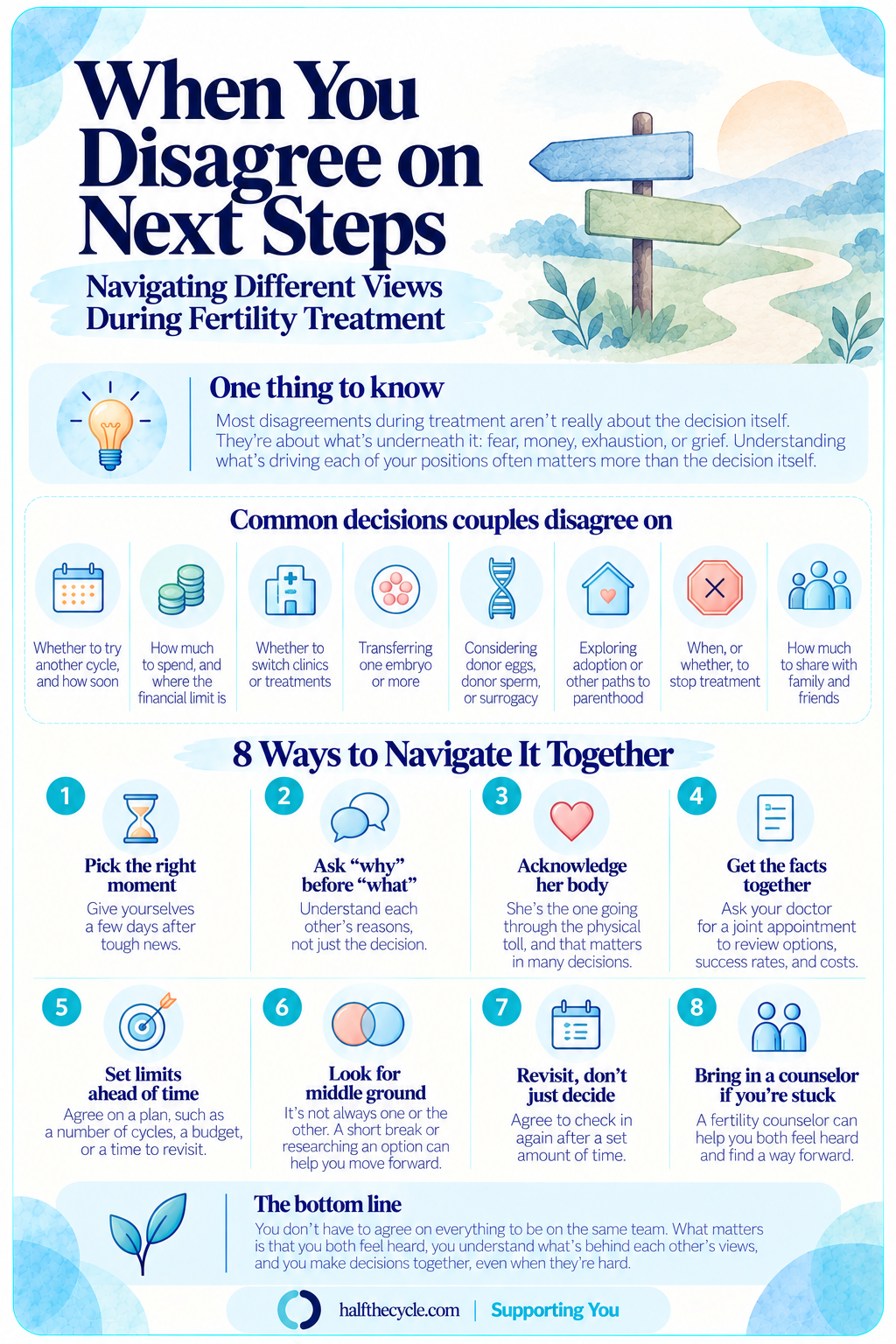
What helps
1. Pick the right moment
Big decisions are harder to talk through right after bad news, when emotions are raw. If you can, give yourselves a few days before making a major call.
2. Ask "why" before "what"
Instead of debating the decision, try to understand each other's reasons. Something like "What worries you most about trying again?" or "What makes you want to keep going?" can open up a much more honest conversation.
3. Acknowledge that her body is part of the equation
She's the one going through the injections, procedures, and physical toll, and that gives her a unique stake in many of these decisions. That doesn't mean your view doesn't matter. It means some decisions need to weigh her physical and emotional limits carefully.
4. Get the facts together
Disagreements often come from different information or assumptions. Ask your doctor for a joint appointment to talk through success rates, options, and costs, so you're both working from the same picture.
5. Set limits ahead of time
Some couples find it helps to agree on a plan before starting the next step, such as a number of cycles, a budget, or a time to revisit. Deciding in a calmer moment can make the hard moments easier.
6. Look for middle ground
It's not always one or the other. Taking a short break, trying one more cycle before reconsidering, or researching an option without committing to it can help you move forward without either person feeling overruled.
7. Revisit, don't just decide
Your feelings may change over time, and that's okay. Agree to check in again after a set amount of time, rather than treating every decision as final.
8. Bring in a counselor if you're stuck
If you keep circling the same disagreement, a counselor who specializes in fertility can help you both feel heard and find a way forward. This is especially helpful for decisions like donor options or stopping treatment.
The bottom line
You don't have to agree on everything to be on the same team. What matters is that you both feel heard, you understand what's behind each other's views, and you make decisions together, even when they're hard.